Why Is My Sourdough Bread Dense and Heavy? 5 Fixes for Fluffy Bread
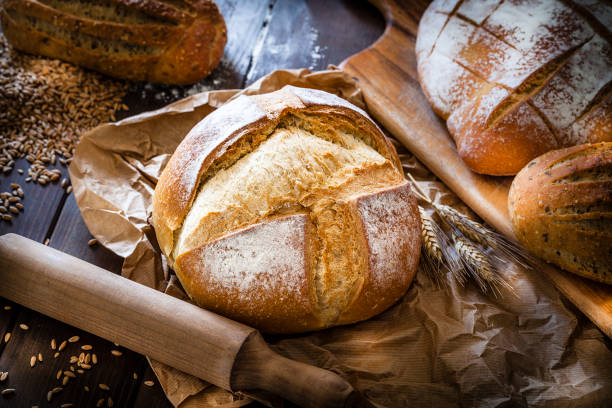
Why is my sourdough bread dense and heavy? This common failure is primarily caused by a weak or acidic starter, under-fermentation during the bulk rise, or using low-protein flour. To fix this, you must learn how to peak your starter, identify the “jiggle” in your dough, and trap steam effectively during the bake.
You slice into your loaf. You expect an airy, open web of gluten. Instead, the knife drags through resistance. The cross-section reveals the truth: a tight, gummy texture that looks more like a damp sponge than artisan bread. It feels heavy in your hand, almost like a brick.
This is the most frustrating moment in sourdough baking. You invested three days of waiting, folding, and shaping, only to fail at the finish line. But here is the good news: Bread is not magic. It is biology. Every dense loaf is leaving you physical clues about what went wrong.
If you are asking, “Why is my sourdough bread dense and heavy?” you are likely missing one of five critical variables. Let’s dissect the science of the crumb and turn that brick into a cloud.
The Diagnosis: Interpreting the Crumb
Before we fix the process, look closely at the failure. The pattern of the density tells us exactly which error occurred.
1. The “Fool’s Crumb” (Under-Fermented)
This is the most common issue for beginners. You see large, wild tunnels or holes, but they are surrounded by dense, solid dough.
- The Cause: The yeast was active enough to create some gas bubbles, but the dough wasn’t fermented long enough for those bubbles to spread evenly.
- The Verdict: You cut the bulk fermentation too short.
2. The “Flying Crust” (Weak Structure)
There is a massive cavern of air right under the top crust, but the bottom half of the loaf is a compressed, gummy layer.
- The Cause: The gluten structure was too weak to hold the gas, or the oven wasn’t hot enough to set the structure before the gas escaped upward.
- The Verdict: Weak flour or poor shaping technique.
3. The “Solid Brick” (Inactive Starter)
The entire loaf is uniform, tight, and heavy. There are almost no visible air pockets.
- The Cause: There was virtually no yeast activity.
- The Verdict: Your starter was dead, too young, or too acidic.
Variable 1: The Engine (Your Starter Health)
You cannot bake a Formula 1 car with a lawnmower engine. If your starter is sluggish, your bread will be dense. Period. Many bakers use a starter that is technically “alive” but not “strong.”
The “Float Test” is a Myth
Stop relying on the float test. A starter can float because it has trapped gas, yet still lack the yeast population density required to lift 500g of flour.
The Real Metric: Time-to-Double
You need to track performance. A bread-ready starter should:
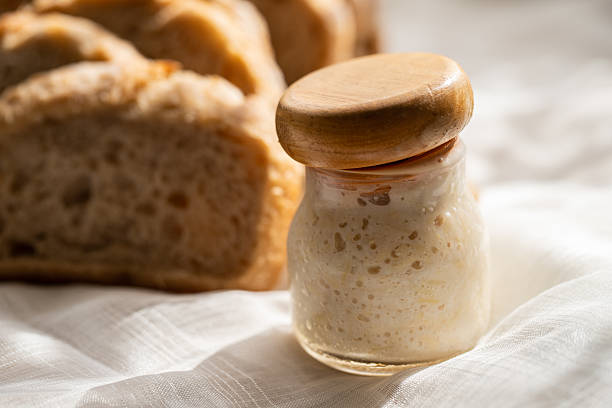
- Double in size within 4 to 6 hours.
- Temperature matters: This applies at a standard room temperature of 74°F – 76°F (23°C – 24°C).
- Smell: It should smell like ripe fruit, yogurt, or yeast. If it smells strictly like nail polish remover (acetone), it is hungry and acidic.
How to Boost Yeast Population
If your starter takes 8+ hours to double, it is too weak for bread. You need to strengthen it before baking.
- Stop the 1:1:1 Ratio: Feeding 10g starter, 10g flour, and 10g water is fine for maintenance, but it doesn’t challenge the yeast.
- Switch to High Ratios: The night before you bake, feed your starter a 1:5:5 ratio (e.g., 10g starter, 50g flour, 50g water).
- The Result: This forces the yeast to reproduce aggressively to consume the abundant food. By morning, you will have a powerhouse culture ready to lift even the heaviest dough.
Variable 2: Bulk Fermentation (The Main Culprit)
This is where 80% of dense loaves are created. Bulk fermentation is the time between mixing your dough and shaping it.
The “Recipe Clock” Trap
Most recipes lie to you. They say “Let rise for 4 hours.” However, the author’s kitchen might be 80°F, while yours is 68°F. That 12-degree difference changes everything. In a cool kitchen, “4 hours” leads to severe under-fermentation.
If you shape under-fermented dough, the gluten network hasn’t relaxed. The gas is trapped in tight pockets. When it hits the oven, it can’t expand.
The Visual Checklist for Readiness
Ignore the clock. Watch the dough. Do not move to the shaping step until you see these three signs:
1. Volume Increase (30% to 50%)
Do not wait for the dough to “double” (100% rise) during bulk fermentation. If it doubles in the bowl, it will run out of food in the oven and collapse. Aim for a 30% to 50% rise.
🍞 Pro Tip: The Aliquot Jar It is hard to judge volume in a round bowl. Tear off a small piece of your mixed dough (about 20g) and stuff it into a small, straight-sided spice jar or shot glass. Mark the starting level with a rubber band. Keep this jar next to your main bowl. When the dough in the jar hits the 50% rise mark, your main dough is ready.
2. The Wobble Test
Shake the bowl gently.
- Not Ready: The dough moves like thick mud or water.
- Ready: The dough jiggles like Jell-O or pudding. It should look aerated and lively.
3. Surface Tension
The dough should pull away slightly from the sides of the bowl. You should see bubbles forming under the surface, looking like blisters.
Variable 3: Flour Protein Content
The gas produced by yeast inflates the dough, but the gluten is the balloon that holds that gas. If your balloon is weak, it pops, and the bread collapses.
AP Flour vs. Bread Flour
Why is my sourdough bread dense and heavy when I use All-Purpose (AP) flour? Standard AP flour typically has a protein content of 10-11%. Sourdough is acidic. Acid degrades gluten. If you start with weak gluten (AP flour) and subject it to a long, acidic fermentation, the structure breaks down.
The Fix:
- Switch to Strong Bread Flour with 12.5% to 14% protein.
- This higher protein creates a stronger “net” that can trap carbon dioxide effectively.
- If you must use AP flour, reduce the water content (hydration) to 65% to make the dough more manageable.
The Autolyse Advantage
To maximize fluffiness, mix your flour and water (without salt or starter) 1 hour before you begin. This process, called “Autolyse,” allows the gluten to form passively. It creates an extensible structure that expands easily in the oven without tearing.
Variable 4: Handling and Shaping
You have fermented the dough perfectly. It is full of delicate air bubbles. Now, you must shape it without destroying your hard work.
The “Iron Hand in a Velvet Glove”
Beginners often shape too aggressively. They press the dough flat to get a tight shape.
- The Mistake: You are mechanically degassing the dough. You are popping the bubbles you waited hours to create.
- The Fix: Handle the dough gently. Rely on tension, not pressure. Use a bench scraper to pull the dough across the counter to create surface tension, but try to preserve the air inside.
The Second Proof (Retard)
After shaping, most bakers put the dough in the fridge. This is crucial. Cold dough holds its shape better. However, if your fridge is too cold (below 38°F/3°C), yeast activity stops completely. Ensure your fridge is around 39°F-40°F so a tiny bit of slow fermentation continues, improving the crumb openness.
Variable 5: The Oven Spring and Steam
The first 20 minutes of baking are critical. This is when “Oven Spring” occurs—the rapid expansion of gas before the crust sets.
Thermal Shock
Yeast dies at 140°F (60°C). You want the loaf to expand fully before the internal temperature hits 140°F. This requires massive heat.
- Preheat: Set your oven to 500°F (260°C).
- Heat Soak: Let your Dutch oven preheat for at least 45 minutes to store thermal energy.
The Role of Steam
If you bake in a dry oven, a hard crust forms in 2 minutes. This crust acts like a steel cage. The dough tries to expand, hits the hard crust, and stops. The result is a dense interior.
- Dutch Oven Method: Keeping the lid on traps the moisture evaporating from the dough. This steam keeps the crust soft and flexible, allowing maximum expansion.
- Open Bake Method: If you don’t use a Dutch oven, you must add a tray of lava rocks or boiling water to the bottom of the oven to generate steam.
The Patience Rule: Don’t Slice It Hot
This is the final hurdle. You pull a golden loaf from the oven. It smells incredible. You want to cut it immediately.
Stop.
Inside that hot loaf, a process called starch retrogradation is happening. The starches are still gelatinized (wet and gooey). They need to cool down to set into a solid structure.
If you cut a loaf while it is hot (or even warm):
- Steam escapes instantly.
- The structure collapses.
- The crumb turns into a gummy, rubbery paste.
- You ruin a perfect loaf in 5 seconds.
Wait at least 2 hours. Ideally, wait 4 hours until the loaf is completely cool to the touch. This ensures a dry, fluffy, cotton-soft crumb.
Ready to Bake Again?
Fixing a dense loaf isn’t about luck. It is about control.
- Feed your starter a 1:5:5 ratio tonight.
- Buy high-protein bread flour.
- Watch for the 50% rise and the “jiggle” during bulk fermentation.
- Bake hot with steam.
The difference between a brick and a cloud is simply learning to read the dough’s language. Dust off your banneton and try again.
Frequently Asked Questions
How do I know if I over-proofed my dough?
Over-proofed dough loses its structure. Instead of a dome, it spreads out like a pancake in the oven. The crumb will be dense at the bottom but might have jagged, tearing holes. Unlike under-proofing (which looks tight), over-proofing looks “exhausted.”
Can I eat dense sourdough bread?
Yes, absolutely. Unless it is raw in the middle, it is safe to eat. It might be chewy, but the flavor is still there. If it is too dense to enjoy as toast, turn it into croutons, bread pudding, or pulse it into breadcrumbs.
Why is my sourdough gummy even after cooling?
This usually points to baking temperature. If you cut it cool and it’s still gummy, you likely didn’t bake it long enough. The internal temperature of the bread must reach 208°F – 210°F (97°C – 99°C). If you pull it out at 200°F, the excess moisture remains inside.
Does high hydration make bread fluffier?
Not automatically. High hydration (more water) can lead to a more open crumb, but it is much harder to handle. If you lack the skill to shape wet dough, you will degas it, resulting in a flat, dense loaf. It is better to master a 65-70% hydration loaf first.
My starter smells like vinegar/acetone. Is it bad?
It is not “bad,” but it is hungry. A strong vinegar smell means the bacteria have produced a lot of acid. Acid destroys gluten. Discard 90% of it and give it a large refreshing feeding (1:5:5) to dilute the acid and encourage fresh yeast growth.