
5 Reasons Why Is My Bread Not Rising in the Oven & How to Fix It
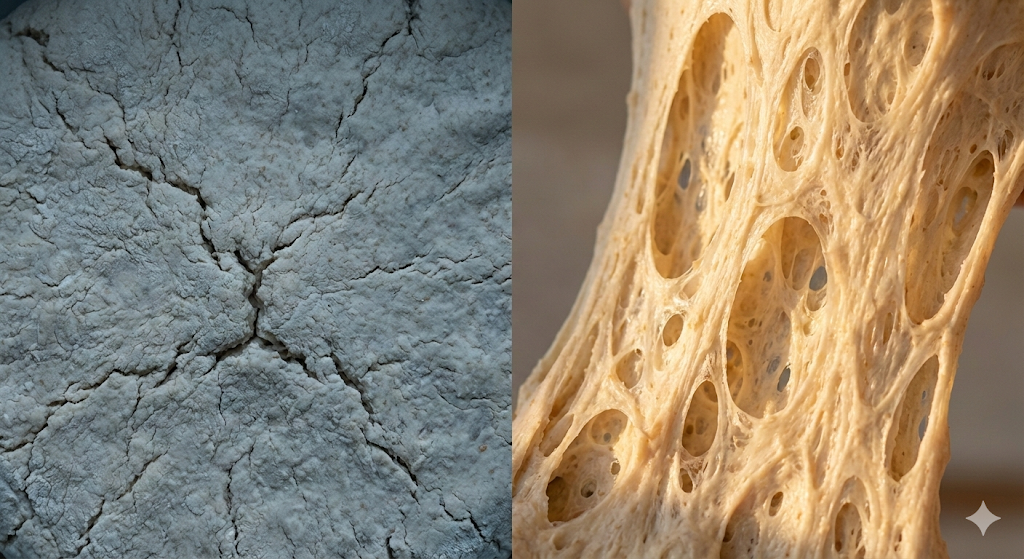
Why is my bread not rising in the oven?? The most common reason isn’t dead yeast, but over-proofing. When dough rises too long on the counter, the gluten network becomes “exhausted” and cannot hold the gas expansion when hit with heat. Other critical factors include a lack of steam creating a hard “crust prison” before the center expands, or an oven that hasn’t reached the correct radiant temperature, causing the yeast to die before it can give that final push known as “oven spring.”
Why Is My Bread Not Rising in the Oven? (It’s Likely Not the Yeast)
We have all been there. You spend 24 hours nurturing a sourdough starter, you mix, you fold, and you watch that beautiful dough rise on the counter. It looks perfect—puffy, jiggly, full of life. You gently slide it into the heat, expecting a masterpiece. But forty minutes later, you pull out a dense, flat disk that looks more like a frisbee than a loaf of artisan bread.
As a baker who has consulted for dozens of small micro-bakeries and café startups, I can tell you that this is the single most frustrating moment in the business. It’s not just a failed recipe; it’s lost time, wasted inventory, and lost revenue.
When I ask clients, “Why is my bread not rising in the oven?”, their first instinct is almost always to blame the ingredients. They buy more expensive yeast or switch flour brands. But in my fifteen years of baking, I have found that 90% of the time, the ingredients are fine. The problem is usually physics, not biology. Specifically, you are likely missing the critical “Oven Spring” window—that magical first ten minutes of baking where the magic happens.
If you are trying to scale up your home baking into a business, you can’t afford to guess. Let’s dig into the science of why your loaves are falling flat and, more importantly, how to stop it from happening again.
⚠️ Important!
If you are using trendy ancient grains like Einkorn or Rye (which are huge in 2025), stop treating them like white bread flour. Their gluten structure is weaker. If you treat them the same, they will almost always collapse in the oven.
The “Oven Spring” Phenomenon: Why Bread Rises (or Dies) in the First 10 Minutes
To understand the problem, we have to look at what is supposed to happen when you shut that oven door.
Many beginners think the rising happens mostly on the counter. That is only half the story. The most dramatic expansion happens immediately after the dough hits the heat. This is called Oven Spring.
Here is the practitioner’s reality: When dough enters a 450°F (230°C) oven, the yeast goes into a frenzy. It’s a “last gasp” of activity where the yeast produces gas rapidly before the heat kills it (usually around 140°F internal temp). Simultaneously, the gases already trapped in the dough expand due to the heat.
If you are asking, “why is my bread not rising in the oven?”, it is usually because this specific chain reaction was interrupted.
I remember a case with a client in Chicago who was trying to ramp up bagel production. Her bagels were perfect on the tray but flat coming out of the oven. We discovered her oven wasn’t recovering heat fast enough after loading 12 trays at once. The “spring” wasn’t happening because the thermal shock was too weak. It wasn’t the recipe; it was the heat management.
The 3 “Silent Killers” of Oven Spring (That No One Talks About)
If your yeast is alive and bubbling in the bowl, but the bread fails in the bake, you are likely dealing with one of these three silent killers.
Is Your Dough “Exhausted”? Why “Doubling in Size” is a Dangerous Lie
This is the most controversial advice I give, but I stand by it: Stop waiting for your dough to double in size.
In nearly every old cookbook, you read “let rise until doubled.” For a commercial bakery or a serious home business, this is dangerous advice. If your dough has truly doubled on the counter, it might already be too late.
Here is the field context: Think of your gluten network like a rubber balloon. On the counter, the yeast blows air into that balloon. If you let it inflate to its absolute maximum capacity (doubling or tripling) before it hits the oven, what happens when the oven heat causes that gas to expand further?
Pop.
The balloon bursts. The structure collapses. The gas escapes. And you are left wondering, why is my bread not rising in the oven? It didn’t rise because it had nothing left to give. It was “exhausted.”
My Recommendation: Aim for a 75-80% rise on the counter. You want the dough to feel “puffy” but still have some tension. You need to leave some room in the tank for that final expansion in the oven. If it looks fully grown on the counter, it’s going to be flat on the cooling rack.
The “Crust Prison”: How Your Oven’s Dry Air is Physically Trapping Your Loaf
Imagine trying to blow up a balloon that is encased in concrete. No matter how much air you pump in, it cannot expand.
This is exactly what happens in a dry oven.
When dough hits the hot air, the surface wants to dry out instantly. If it creates a hard, dry crust within the first two minutes, the inside of the loaf—which is still trying to expand—hits a brick wall. The crust sets too early, trapping the loaf in a “prison” of its own skin.
Professional deck ovens inject massive amounts of steam to keep the crust soft and flexible for the first 10-15 minutes. This allows the bread to stretch and jump up.
Field Experience: I once worked with a bakery that had their steam injector break. For three days, every single baguette came out looking like a breadstick. We didn’t change the dough; the lack of humidity just physically constricted the rise.
If you are baking at home or in a small shop without steam injection ovens, you absolutely must create your own steam (I’ll share how in the solution section below). If you don’t, you will constantly battle the “crust prison.”
The Temperature Shock: Why “Preheated” Might Not Mean “Ready”
Your oven beeps. The display says 450°F. You slide the bread in. It comes out flat. Why?
Because air temperature is not the same as radiant heat.
Most consumer and prosumer ovens have a sensor that measures the air. But to get a massive oven spring, you need the walls, the floor, and the baking stone to be saturated with heat.
If you open the door to load your bread, you instantly lose 50-100 degrees of air temperature. If the walls of the oven aren’t thoroughly soaked with heat (radiant energy), the oven struggles to climb back up. That critical “kick” the yeast needs in the first 5 minutes doesn’t happen. instead, the dough slowly warms up, the yeast dies a slow death, and the structure sets before it can rise.
The Fix: When your oven beeps that it’s “ready,” it’s lying to you. Wait another 30 to 45 minutes. You need the thermal mass of the oven to be scorching hot to prevent your bread from not rising in the oven.
Troubleshooting the “Dense Brick”: A Texture Diagnosis Guide
When you slice into a failed loaf, the crumb (the inside texture) tells a story. It is like a forensic report. As a bakery consultant, I don’t just look at the outside; I look at the hole structure to diagnose exactly why is my bread not rising in the oven.
Here is how to read your bread like a pro:
Scenario A: Dense, Gummy, and Tight at the Bottom
The Verdict: Under-Proofed (The “Flying Crust”) If your bread has a massive tunnel of air at the very top (separating the crust from the crumb) but the bottom is a dense, gummy brick, you rushed it. The Insight: The yeast still had too much energy. It exploded upward so violently that it tore away from the main dough, but the gluten structure wasn’t relaxed enough to stretch with it. In the shop, we call this a “flying crust.” It means you put the dough in the oven way too soon.
Scenario B: Flat Shape with Large, Irregular Holes
The Verdict: Over-Proofed (The “Fool’s Crumb”) This is the trickiest one. You cut it open and see some big holes, so you think, “Hey, it rose!” But the loaf itself is flat like a pancake. The Insight: This is “Fool’s Crumb.” Those big holes aren’t from healthy rising; they are from the gluten network collapsing and merging air pockets together because the structure was weak. If your loaf spreads outward rather than upward, you let it sit on the counter too long.
Scenario C: Pale, Heavy, and Zero Air Pockets
The Verdict: The Yeast is Dead or Starved If the loaf looks exactly the same coming out as it did going in—just a hot lump of dough—your leavening agent failed completely. The Insight: Did you mix your yeast with water hotter than 120°F? You likely killed it before you even started. Or, if you are a sourdough baker, your starter might be too acidic (hungry), meaning it destroyed the gluten before it could rise.
How to Rescue a Failed Loaf (Don’t Throw It Away!)
In a home kitchen, a failed loaf is a bummer. In a business, it’s lost margin. As I always tell my workshop students: “We don’t sell mistakes, but we don’t trash ingredients either.”
If you pull a loaf out and realize it’s a brick, here is how to monetize that failure:
- The “Artisan” Crouton: In fact, dense bread makes better croutons than fluffy bread because it holds a crunch longer. Cube it, toss it with olive oil, garlic powder, and herbs, and bake at 350°F until golden. Package these near your register. They often sell faster than the bread itself!
- Savory Bread Pudding (Strata): Dense bread is thirsty. It absorbs custard (egg and milk mixture) beautifully without disintegrating. Turn that failed sourdough into a savory breakfast strata with spinach and cheese. It’s an excellent lunch special for a café.
- Old-World Breadcrumbs: Dry the loaf completely in a low oven, then blitz it in a food processor. Homemade breadcrumbs have a texture that panko can’t match, and they are perfect for binding meatballs or topping mac and cheese.
⚠️ Important!
Never try to “re-bake” a loaf that has already cooled down to fix the rise. Once the starch has gelatinized (set) around 180°F internal temp, the structure is permanent. You cannot reverse the chemistry.
The “Poker Face” Test: A 3-Step Solution for Perfect Timing
You want to stop asking “why is my bread not rising in the oven” forever? You need to master the Finger Poke Test.
Forget the clock. The clock is a liar. Ambient temperature, humidity, and flour type change every day. The dough tells you when it’s ready, not the timer.
Here is the protocol I use in commercial kitchens to determine the exact moment to bake:
- The Setup Flour your index finger slightly so it doesn’t stick to the dough. Find a spot on the dough that isn’t too floury.
- The Poke Gently press your finger into the dough about half an inch (1-2 cm) deep. Do not jab it; press it like you are ringing a doorbell.
- The Reading (Crucial Step) Watch how the dough rebounds:
- Springs back instantly and completely: The dough is Under-proofed. The gluten is still too tight. If you bake now, it won’t expand properly (Scenario A). Let it sit longer.
- Stays indented and doesn’t move: The dough is Over-proofed. It has no gas pressure left to push back. You missed the window. Bake immediately and pray.
- Springs back slowly but leaves a small indentation: This is PERFECT. It means the dough has gas pressure (it’s pushing back) but is relaxed enough to expand (it doesn’t snap back instantly). Get it in the oven now!
FAQ: Common Struggles for Emerging Bakers
Q: Can I re-knead dough that didn’t rise and start over? Technically, yes, but only if the yeast is still active (under-proofed). However, I rarely recommend this for a business. The second rise will produce a much tighter, funkier flavor due to yeast exhaustion. If you are just practicing at home, go for it. If you are selling to customers, turn that dough into a flatbread or pizza base instead. It’s safer to sell a great flatbread than a mediocre loaf.
Q: Why does my bread rise in the oven but then collapse immediately? This is a classic sign of over-hydration coupled with low heat. If your oven isn’t hot enough to “set” the structure quickly, gravity will eventually win. The gas expands, the gluten stretches, but the structure doesn’t harden in time, so it implodes. Crank up your oven temperature by 25°F next time.
Q: Does the type of baking tray affect the rise? Absolutely. If you are wondering why is my bread not rising in the oven and you are using a thin, shiny aluminum cookie sheet, that’s your problem. Thin metals don’t conduct heat fast enough to the bottom of the loaf. Use a baking stone, a cast-iron skillet, or a heavy-duty Dutch oven to ensure that thermal shock hits the dough instantly.
Master the Heat, Master the Rise
Bread baking is a conversation between you and the dough. When you ask, “why is my bread not rising in the oven?”, the answer is usually that you stopped listening to what the dough was telling you.
It wasn’t dead; it was either screaming for help because the crust was hardening too fast, or it was exhausted from running a marathon on your countertop.
Take these insights back to your kitchen. Buy an oven thermometer to check your real heat. Use the Poke Test religiously. And remember, even the best bakers in the world produce a brick now and then. The difference is, they turn that brick into the best croutons in town and keep moving forward.
Now, go feed your starter. It’s waiting for you.