7 Ways How to Keep Muffins Moist While Baking Using The Overnight Protocol
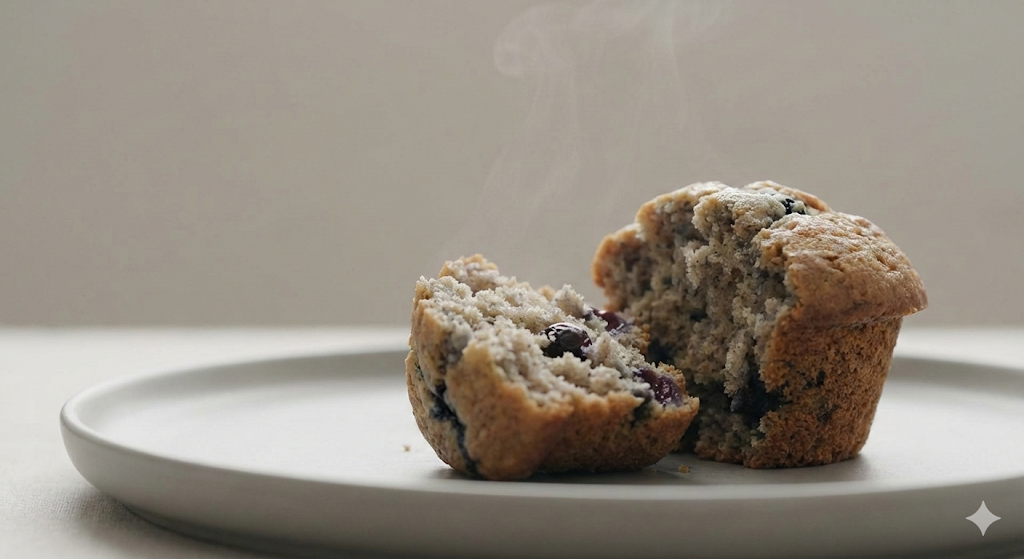
To master how to keep muffins moist while baking, you must move beyond simple ingredients and focus on the “Overnight Protocol.” This involves resting your batter in the refrigerator for 12-24 hours before baking, which allows the flour starches to fully hydrate and swell. Combined with a “Hybrid Fat” strategy (using a 50/50 split of oil and butter) and baking at a high initial temperature, this ensures a bakery-style dome that locks moisture inside for days, not just hours.
The Struggle of the “Hockey Puck” Muffin
We need to talk about that sinking feeling every baker knows. You pull a tray of golden, high-domed blueberry muffins out of the oven, and they look absolutely magazine-worthy. The smell fills your shop, and you feel like a pro. But then, the real test happens 24 hours later. You grab a leftover muffin to check the quality, take a bite, and… it’s dry. It crumbles like sawdust in your mouth.
In my 15 years running kitchens and consulting for bakery startups, this is the number one complaint I hear. “My muffins are great fresh, but they turn into bricks by the afternoon.” It is frustrating because you aren’t just losing product; you are losing repeat customers. A customer who chokes on a dry muffin isn’t coming back for a second one.
Here is the hard truth: Most home recipes do not scale well for business. What works for a Sunday brunch with the family often fails in a commercial display case. You need a strategy that fights physics. In this guide, I’m going to walk you through the exact protocols I teach my clients—specifically the “Overnight Protocol”—to ensure your product stays tender and profitable. For foundational food safety guidelines regarding cooling and storage, I always recommend referencing standards from www.usda.gov, but today we are going deeper into the specific chemistry of texture.
The Science of Moisture and Why Your Muffins Dry Out
Before we fix the problem, we have to understand what is actually happening inside your oven. A lot of new shop owners think that how to keep muffins moist while baking is simply about not overbaking them. While timing matters, the real culprit is usually a lack of hydration capacity.
In the field, I often explain it like this: Flour particles are like tiny, dry sponges. If you mix your batter and immediately throw it in the oven, those sponges haven’t had time to fully soak up the liquids (milk, eggs, oil). When the heat hits, the water evaporates before it can be locked into the starch structure.
The Reality vs. The Recipe Book Most cookbooks tell you to “bake immediately after mixing” because they are afraid the baking powder will lose its power. In a high-volume business setting, this is bad advice. I have encountered countless cases where immediate baking resulted in a “tight” crumb that felt dry even when it was technically fresh. The moisture has to be bound to the structure, not just sitting loosely inside it.
⚠️ Important! Never judge a muffin’s moisture level while it is still hot. Steam mimics moisture. The true test of your recipe is how it feels after it has completely cooled to room temperature. If it feels dry then, your ratio of fat to flour is likely off.
The Steam Trap Trick That Stops Staling Before It Starts
This is a controversial topic for some, but in the commercial world, it is standard practice. We call it “The Steam Trap.”
The biggest enemy of your muffin is retrogradation. This is a fancy scientific term for the starch molecules recrystallizing and hardening—basically, the process of going stale. This process starts the second the muffin begins to cool down.
How we handle this in the bakery: We do not let the muffins cool completely on an open wire rack in a drafty kitchen. That is a recipe for disaster. Instead, once the muffins are cool enough to handle but still faintly warm (I’m talking barely warm to the touch), we loosely cover them or place them in a semi-enclosed rack.
This traps a very small amount of residual steam near the crust. This keeps the crust soft and prevents that hard “shell” from forming too early. I recently helped a client in a humid coastal town who was leaving her muffins out under a fan to “cool faster.” By changing just this one step—turning off the fan and covering them earlier—she added an entire day to her product’s shelf life.
The Hybrid Fat Strategy for Flavor and Texture
This is where I see the most arguments in the culinary world. Butter purists versus the Oil pragmatists.
- Butter: Provides incredible flavor and mouthfeel. However, butter is 15-20% water, and at room temperature, it is a solid. This means when your muffin cools down, the butter solidifies, making the muffin feel denser and drier.
- Oil: It is 100% fat and remains liquid at room temperature. This guarantees a sensation of moistness. But let’s be honest, an all-oil muffin can taste greasy and bland.
So, what is the solution? I recommend the Hybrid Fat Strategy. To truly master how to keep muffins moist while baking, you should use a 50/50 split.
I tested this extensively with a startup bakery in Chicago. They were using an all-butter recipe that cost them a fortune and yielded dry results. We switched to using 50% melted unsalted butter (for that premium flavor profile) and 50% neutral vegetable oil (canola or grapeseed) for texture. The result was a muffin that tasted expensive but stayed soft for three days.
Stop Using Milk and Switch to Sour Cream or Buttermilk
If your current recipe calls for regular whole milk, I want you to reconsider that immediately. Regular milk is fine for a bowl of cereal, but in baking, it is basically just flavored water. It doesn’t bring enough to the table structurally.
To get that velvety, melt-in-your-mouth texture, you need acidity.
Acidity does two miraculous things:
- It tenderizes the gluten strands in the flour (preventing toughness).
- It reacts with baking soda to create a better rise.
My Recommendation: Swap your milk for full-fat sour cream or thick buttermilk. In fact, I often swap 50% of the liquid in a recipe for sour cream. The high fat content and thick consistency of sour cream add a richness that milk simply cannot compete with.
I once worked with a home baker looking to scale up who was terrified of using sour cream because she thought her blueberry muffins would taste “sour.” I had to convince her to do a blind taste test. She was shocked. You don’t taste the sourness; you just taste a deep, rich, moist crumb that feels luxurious. It is the secret weapon for anyone wondering how to keep muffins moist while baking consistently.
The Baking Process: Temperature Shock and The Toothpick Myth
Now that your batter is perfect, we have to talk about how you bake it. Many shop owners set their ovens to 350°F (175°C) and walk away. This is a “safe” method, but it is not the best method for moisture retention.
If you bake at a moderate temperature the whole time, the muffin rises slowly. This slow rise allows more time for moisture to evaporate before the crust sets.
The Fix: The 425°F to 350°F Switch I teach a method called “The Blast.” You start your oven hot—425°F (220°C). You put the muffins in for exactly 5 to 7 minutes. This intense heat forces the leavening agents (baking powder/soda) to explode upward rapidly, creating that high, professional dome.
Once that dome is set, you drop the temperature to 350°F (175°C) for the remainder of the bake. Why does this help with moisture? Because the high dome creates a smaller surface area relative to the volume, and a set crust acts as a lid, trapping the steam inside for the rest of the baking cycle.
The Toothpick Trap We need to unlearn a bad habit. If you stick a toothpick in the center and it comes out “clean,” you have already overbaked your muffin. A clean toothpick means every bit of moisture in the center has been cooked off.
Field Tip: You want the toothpick to come out with a few moist crumbs clinging to it. Not raw batter, but sticky crumbs. This indicates that the center is fully cooked but still hydrated. The residual heat will finish the job as they cool on the pan.
The “Overnight Protocol” (Step-by-Step Guide)
This is the most powerful tool in your arsenal for solving how to keep muffins moist while baking. It requires patience, but the payoff is a product that is superior to 90% of your competition.
This method works because it allows the flour to fully hydrate and the gluten to relax. Think of it like marinating meat—the longer it sits, the better the texture.
1. Mix Your Wet and Dry Ingredients Prepare your batter as usual. Do not overmix! Stop as soon as you see no more streaks of dry flour. Lumps are your friends here; they hold moisture pockets.
2. Cover and Chill Do not scoop the batter into the tins yet. Leave it in the mixing bowl. Cover the surface of the batter directly with plastic wrap (touching the batter) to prevent a skin from forming. Then, cover the bowl again. Place it in the refrigerator.
3. The 12-Hour Rest Let the batter sleep for at least 12 hours, up to 24 hours. During this time, the starch molecules are soaking up the liquid like a sponge. This “pre-soak” means the water is now chemically bound to the starch, making it much harder for it to evaporate during baking.
4. Scoop Cold, Bake Hot The next morning, do not let the batter come to room temperature. Scoop the cold, stiff batter directly into your lined muffin tins. The cold batter hitting the hot oven (remember the 425°F blast?) creates an even better rise and a more tender interior.
Storage Hacks to Maintain Moisture for 3 Days
You have baked the perfect muffin. Now, how do you sell it on Day 3?
- The Paper Towel Trick: If you are storing muffins in a plastic container, place a paper towel at the bottom and one on top of the muffins. The paper towel absorbs excess condensation (which makes them soggy) but creates a humid micro-climate that prevents them from drying out.
- Avoid the Refrigerator: Never, ever put baked muffins in the fridge. A refrigerator is actually a dehydrator. It speeds up the staling process (retrogradation) by nearly 6 times compared to room temperature. Store them at room temperature or freeze them immediately.
Heading: Ready to Transform Your Bakery Case?
Running a food business is a game of consistency. Your customers don’t just want a good muffin once; they want it every single time they visit. By implementing the “Overnight Protocol” and switching to a hybrid fat ratio, you aren’t just learning how to keep muffins moist while baking; you are building a reputation for quality.
Don’t be afraid to experiment. Take your current recipe, split the batch in half, and try the overnight rest with one half. The difference in the crumb structure will speak for itself. Your customers will notice, and your sales will reflect that quality.
FAQ (Frequently Asked Questions)
1. Can I use this overnight method if my recipe uses baking soda? Yes, but be careful. Baking soda reacts immediately when it hits acid (sour cream/buttermilk). If you rest a baking soda batter too long, it might lose some lift. For overnight success, I recommend using “Double Acting” baking powder, which releases gas a second time when it hits the heat of the oven, ensuring you still get a great rise even after a long rest.
2. Why are my muffins sticky on top the next day? That sticky top is actually a sign of moisture! It happens when moisture migrates from the center to the crust. If you dislike it, you can refresh the muffins in a 350°F oven for 3-5 minutes before serving. This re-crisps the top while keeping the inside soft. However, most customers actually enjoy that soft, sweet, sticky top.
3. Is it better to use paper liners or grease the pan? For moisture retention, paper liners are superior. Direct contact with a hot metal pan creates a thicker, harder crust which can dry out the sides. Paper liners act as a tiny insulator, keeping the sides of the muffin tender and soft. Plus, they make your product look more sanitary and professional in a display case.