7 Advanced Chili Oil Infusion Tips for Complex Flavor & Profit
Last Updated on 2025-12-26 by Suryo

Chili oil infusion tips often focus on ingredients, but the secret to a commercial-grade product lies in thermodynamics. For maximum flavor extraction without bitterness, maintain your oil temperature strictly between 225°F and 250°F (107°C – 121°C). Below this range, the aromatics remain dormant; above it, the capsaicin degrades and the flakes carbonize, ruining the shelf life of your product.
Beyond the Burn Advanced Chili Oil Infusion Tips for Complex Flavor
We need to be honest with each other right now. If your current method involves dumping red pepper flakes into a pot of boiling oil and hoping for the best, you aren’t making chili oil—you are making burnt pepper soup. In my 15 years of developing recipes and consulting for condiment brands, I have seen more batches ruined by impatience than by bad ingredients.
The difference between a jar of “okay” spicy oil and the kind of product that customers line up for at a farmers market isn’t the rarity of your peppers. It is temperature control. I remember walking into a client’s commercial kitchen last year; the air was thick with acrid smoke, and everyone was coughing. They were pouring 375°F oil directly onto delicate Sichuan flakes. They weren’t extracting flavor; they were incinerating it. Whether you are running a dumpling stall or bottling your own line of sauces, mastering these chili oil infusion tips will save you money on wasted ingredients and protect your brand’s reputation.
For general food safety guidelines regarding oil and preservation, you can always refer to the USDA resources, but let’s get into the specific mechanics of flavor extraction that the textbooks often leave out.
The Thermodynamics of Spice Why Temperature Matters More Than Time
Many beginners in the food business think that “longer is better.” They assume that if they leave the chilies on the stove for an hour, they will get a stronger product. In the field, I have found that this logic is actually backwards. Heat is a tool, not a timer.
The science here is simple but critical: you are trying to extract capsaicin (heat) and essential oils (flavor/aroma) from a dried plant matter.
- The “Cold” Zone (Below 200°F): If your oil is too cool, the chili flakes will just soak up the grease. You end up with a heavy, oily texture and very little actual spice.
- The Danger Zone (Above 275°F): This is where most shops fail. At this temperature, the sugars in the dried peppers caramelize rapidly and turn to carbon. Once that bitter, “ashy” taste enters your oil, you cannot filter it out. It permeates everything.
⚠️ Important!
Invest in a high-quality digital laser thermometer. Do not guess. The “shimmer” of the oil is not an accurate measurement. A difference of 15 degrees can be the difference between a golden, aromatic infusion and a dark, bitter waste of inventory.
My golden rule for chili oil infusion tips is to hit the sweet spot: 225°F to 250°F. In this narrow window, the oil is hot enough to bloom the spices and draw out that vibrant red color (from the carotenoids) but cool enough to preserve the fruity, floral notes of the pepper.
Why does my chili oil taste burnt and bitter The Fix
If you have ever tasted your batch and gotten a sharp, metallic bitterness at the back of your throat, you likely scorched your flakes. This happens frequently when scale-up happens—what worked in a small saucepan at home behaves differently in a 20-gallon commercial kettle because the heat retention is massive.
The solution I teach all my clients is the “Staged Pour” Technique.
Instead of dumping all your hot oil onto the spices at once, or dumping all spices into the hot oil, you need to temper the heat. Here is how we do it in a professional setting:
- The Sacrifice: Pour about 20% of your hot oil over your hearty aromatics (like ginger or onion) first. This instantly drops the temperature of the oil in the pot.
- The Sizzle: Pour the next 50% over your coarser chili flakes.
- The Finish: Wait 30 seconds to a minute, then pour the remaining oil over your most delicate powders (like fine cayenne or paprika).
By doing this, you ensure that the most fragile ingredients are never hit with the highest heat. I once helped a client in Chicago who was famous for their “Scorched Earth” sauce—ironically, it tasted like actual scorched earth. We switched them to a staged pour, and suddenly, their customers could taste the citrus notes in the habanero for the first time.
Oil Selection The Vehicle for Flavor
Let’s talk about the base. You can have the best Er Jing Tiao peppers imported from Chengdu, but if you use the wrong carrier oil, you are fighting a losing battle.
A common misconception I see online is the use of Extra Virgin Olive Oil (EVOO). Please, for the sake of your profit margins and flavor profile, do not use EVOO. It has a low smoke point and a very distinct flavor that clashes violently with Asian spices. When you heat olive oil to the temperatures needed for infusion, it breaks down and tastes rancid.
For a commercial product, you generally have two paths:
- The Neutral Canvas (Recommended for Beginners):
- Grapeseed Oil or Canola Oil. These are cost-effective and have high smoke points. They disappear into the background, letting your expensive spices take center stage. If you are selling to a Western market that might be sensitive to strong oil flavors, start here.
- The Flavor Enhancer (The Pro Choice):
- Peanut Oil or Rapeseed Oil (Caiziyou). If you want that authentic, nutty depth found in brands like Lao Gan Ma, this is the secret. However, you must heat raw rapeseed oil to its smoke point first to remove the raw “mustard” smell, then let it cool down to infusion temperature.
I worked with a start-up that insisted on using Avocado oil because it was “trendy.” It drove their cost of goods sold (COGS) through the roof, and nobody could taste the difference once the chili hit. We switched them to a non-GMO Canola base, and their profit margin increased by 18% overnight. Remember, one of the most practical chili oil infusion tips is to spend your budget on the peppers, not the oil.
The Silent Killer in Your Jar: Navigating the Botulism Risk
This is the most serious section of this entire guide. If you ignore everything else I say about flavor, please listen to this for the sake of your customers’ health. In the culinary world, putting raw garlic into oil and sealing it in a jar at room temperature is asking for trouble.
Why? Because Clostridium botulinum—the bacteria that causes botulism—thrives in anaerobic (oxygen-free) environments that have low acidity and moisture. Oil is oxygen-free. Fresh garlic contains water. It is the perfect storm.
I once consulted for a small business that wanted to sell “Grandma’s Garlic Chili Oil.” They were chopping raw garlic, throwing it in warm oil, and bottling it. I had to stop production immediately. The risk is that the spores can grow without you seeing or smelling them.
The Professional Solution: To get that addictive garlic flavor without the risk, you have two safe options included in my top chili oil infusion tips:
- Dehydration: Use dried garlic granules or onion flakes. Since the moisture has been removed, the bacteria cannot grow.
- Deep Frying: You must fry the garlic until it is completely golden and crispy before bottling. This removes the water content. However, for a truly shelf-stable commercial product, I always recommend acidification or using certified dehydrated aromatics to be 100% safe.
The Aromatics First Technique
If you are just mixing chili flakes and oil, you are making a flat product. The best oils on the market have a “base note” that hits you before the spice does. This comes from infusing aromatics before the chili is added.
Think of it like building a perfume. You need base notes, heart notes, and top notes.
- The Base: Star anise, cassia bark (cinnamon), cloves, and black cardamom.
- The Method: I heat the oil with these whole spices first. I let them sizzle gently for 10-15 minutes at a lower temperature (around 225°F). This pulls the essential oils out of the woodier spices.
- The Extraction: Remove these large chunks before adding your chili flakes.
I’ve encountered a case where a client left the star anise in the jar. It looks pretty, but over time, the anise flavor became so overpowering it tasted like medicinal syrup. Extract the flavor, then discard the solids. This keeps your flavor profile consistent from Day 1 to Day 60.
Quick Reference Temperature & Smoke Point Chart
To help you manage your production floor, I have compiled this data based on standard kitchen chemistry. These numbers are your guardrails.
| Oil Type | Smoke Point (Approx) | Best Use Case |
| Grapeseed Oil | 420°F (215°C) | Best All-Rounder. Neutral flavor, high heat tolerance. |
| Canola Oil | 400°F (204°C) | Budget Friendly. Good for high-volume production. |
| Peanut Oil | 450°F (232°C) | Flavor King. Classic choice for Asian condiments. |
| Olive Oil (EVOO) | 325°F-375°F | AVOID. burns too easily and tastes bitter in this application. |
| Dried Chili Burn Point | ~275°F (135°C) | The Limit. Do not cross this temperature or flavor dies. |
Storage and Maturation When is it Ready
Here is a secret that impatient cooks miss: Chili oil is not ready the moment you make it. It needs to “ripen.”
In my experience, the flavor profile at hour 1 is completely different from hour 72. We call this the 3-Day Rule.
- Day 1: The heat is sharp and aggressive. The oil and chili feel separate.
- Day 3: The capsaicin has fully bonded with the oil molecules. The color deepens to a rich mahogany. The flavor becomes rounded and cohesive.
However, oxygen is your enemy here. Once your oil is cool, seal it immediately. Oxidation will turn that vibrant red color into a dull brown within weeks if left exposed. For your business, this means using high-quality jars with tight seals. One of the most overlooked chili oil infusion tips is simply keeping the product away from direct sunlight, which degrades the red pigment rapidly.
Step-by-Step Technical Infusion Guide
Ready to make a batch? Here is the standard operating procedure (SOP) I use for a 5-liter commercial batch.
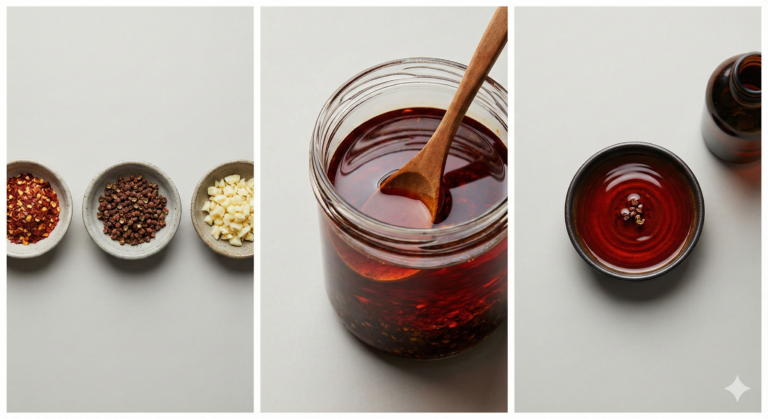
- Prepare the “Dry Mix”: In a large heat-proof steel container (do not use plastic!), combine your Sichuan chili flakes, salt, and any powdered spices (like mushroom powder or sugar).
- Infuse the Base: In a pot, heat your oil to 250°F. Add your whole aromatics (ginger slices, star anise, onions). Fry them until the onions are golden brown and dry.
- Filter and Re-Heat: Strain the oil to remove the solids. Check the temperature. It likely dropped. Bring it back up to exactly 275°F (slightly higher to account for the temperature drop when pouring).
- The Staged Pour:
- Pour 1/3 of the oil over the Dry Mix. Stir vigorously to ensure all flakes are coated.
- Wait 45 seconds. The temperature will drop.
- Pour the remaining 2/3 of the oil. This ensures the first batch “toasts” the chilies while the second batch provides volume without burning.
- The Splash (Optional): Some traditional recipes call for a splash of black vinegar or spirits (baijiu) at the very end. This can help preserve the color, but be careful—it causes aggressive bubbling!
Start Your Flavor Revolution Today
Creating a signature chili oil isn’t about magic; it’s about discipline. It is about respecting the ingredients enough to treat them with the right temperature and care. Whether you are selling online or spicing up your noodle shop’s tables, these chili oil infusion tips give you the foundation to build a product that stands out in a crowded market.
Don’t be afraid to experiment with the aromatics, but never compromise on the technique. The market is full of mediocre, burnt sauces. Yours can be the one that shines.
Frequently Asked Questions (FAQ)
1. Why does my chili oil turn cloudy in the fridge? This is actually a good sign! It usually means you used natural oil without heavy processing. Many oils, especially peanut or olive (if you used it), solidify at cold temperatures. It will clear up perfectly once it returns to room temperature. It does not affect the quality or safety.
2. How long can I keep homemade chili oil? If you followed the safety rules (no raw garlic/water) and used sterilized jars, your oil can last up to 6 months at room temperature. However, for the best flavor, I recommend consuming it within 3 months. If you smell anything “rancid” or like crayons, throw it out—the oil has oxidized.
3. My chili flakes are not crispy, they are soggy. What happened? You likely poured the oil when it was too cold. If the oil is below 225°F, it doesn’t “shock” the flakes enough to drive out the residual moisture and create that crunch. You need that initial high-heat sizzle to get the texture of a true chili crisp.