5 Dangers Why Pink Salt Isnt Safe for Curing Meat
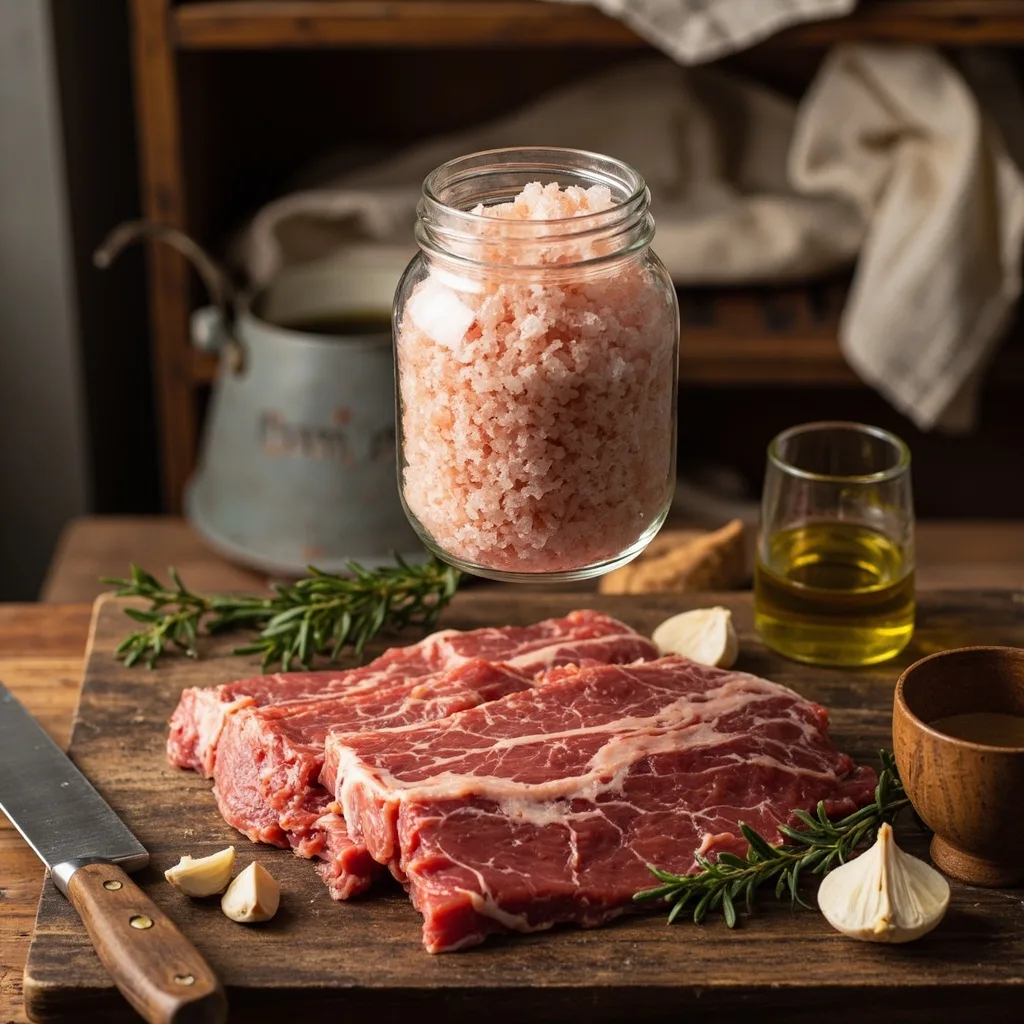
The question “is pink salt safe for curing meat” is one of the most dangerous points of confusion in the modern culinary world. As a chef and food expert with over 20 years of professional experience, my answer is an unequivocal, absolute NO. Using the “pink salt” you buy at the grocery store (Himalayan) to cure meat is not just “less effective”; it is a potentially fatal mistake. The wellness trend promoting Himalayan salt has collided with the science of charcuterie, and the results can be deadly.
This article is a critical food safety announcement. The common mistake is confusing two *entirely different* products that both happen to be pink. Based on our analysis, this confusion is rampant online in DIY forums and wellness blogs. One is a culinary seasoning, and the other is a scientific preservative containing a regulated substance—nitrite—that specifically prevents botulism. We will explore exactly why using Himalayan pink salt for curing meat is unsafe and what you must use instead.
CRITICAL SAFETY WARNING: DO NOT CURE MEAT WITH HIMALAYAN SALT
- Himalayan Pink Salt (Culinary Salt): This is Sodium Chloride (NaCl) with trace minerals. It has ZERO nitrites. It CANNOT prevent botulism.
- Pink Curing Salt (Prague Powder #1): This is ~94% Sodium Chloride and ~6% Sodium Nitrite. It is dyed pink *to prevent you from mistaking it for table salt*. This is the *only* salt that is safe for curing meats like bacon or ham.
- Using Himalayan salt to cure meat creates the perfect environment for deadly botulism spores to grow. This is not an opinion; it is a scientific fact.
The Critical Confusion: Pink Culinary Salt vs. Pink Curing Salt
The entire problem with the query “is pink salt safe for curing meat” lies in semantics. The word “pink salt” has two meanings, and confusing them is a critical error. As a food professional, let me define them clearly.
H3: What is Himalayan Pink Salt (Culinary Salt)?
This is the product you buy in shakers and grinders at the supermarket.
- Composition: It is Sodium Chloride (NaCl), just like regular table salt.
- Why is it pink? Its pink hue comes from trace minerals, primarily iron oxide, that were present in the ancient sea beds where it was mined.
- Culinary Use: It is a finishing salt and seasoning salt. We use it to add flavor, texture, and visual appeal to dishes *that are going to be cooked or eaten immediately*. It has zero preservation power beyond what regular table salt has.
- Preservation Power: None, in the context of curing. It does not contain the necessary compounds to inhibit deadly bacteria.
H3: What is Pink Curing Salt (The ONLY Pink Salt Safe for Curing Meat)?
This is a highly specialized, regulated, and non-culinary product. You cannot buy it at a regular grocery store; you must get it from specialty butcher suppliers.
- Common Names: Prague Powder #1, Instacure #1, Pink Curing Salt #1.
- Composition: It is 93.75% Sodium Chloride (table salt) and 6.25% Sodium Nitrite (NaNO₂).
- Why is it pink? It is intentionally dyed a bright, artificial pink. This is a safety measure. It is dyed to look different from table salt so that no one in a professional kitchen could *ever* accidentally use it to season a steak. A single teaspoon of pure sodium nitrite can be lethal. The dyed-pink curing salt is the industry-standard safety protocol.
- Culinary Use: Its *only* use is for curing and preserving meats that will be cooked before eating (like bacon, ham, or corned beef).
- Preservation Power: This is its sole purpose. The sodium nitrite is the magic ingredient.
The Science of Curing: Why Himalayan Salt is a Deadly Failure
To understand why using Himalayan salt is so dangerous, you need to understand *why* we cure meat. It’s not just for flavor. It is a battle against a silent and invisible killer.
H3: The Enemy: *Clostridium botulinum* (Botulism)
This is the heart of the matter.
- What is it? *C. botulinum* is a bacteria that exists everywhere—in soil, water, and on our food.
- What does it do? In its normal state, it’s not a huge problem. But when it finds an environment it loves, it produces one of the most potent and deadly toxins on planet Earth: botulinum toxin.
- What environment does it love? It thrives in a low-acid, low-oxygen (anaerobic), moist, and room-temperature environment.
Based on our analysis, what have we just described? The *exact* environment you create when you cure a piece of meat. You rub a large piece of pork belly with salt, you seal it in a plastic bag (low oxygen), and you let it sit in the fridge (low acid, moist) for a week. You are creating a five-star resort for botulism spores.
H3: The Hero: How Sodium Nitrite (in Curing Salt) Saves You
This is where the science of “Pink Curing Salt” becomes critical. The sodium nitrite in Prague Powder #1 performs three vital functions that Himalayan salt cannot:
- It Blocks Botulism: This is its #1 job. The nitrite chemical specifically inhibits the germination and growth of *C. botulinum* spores. It is the *only* food-safe ingredient that reliably does this in a curing environment.
- It Creates the “Cured” Flavor and Color: The characteristic sharp, tangy flavor of ham or bacon? That’s the nitrite at work. That beautiful rosy-pink color (even after cooking)? That’s the nitrite reacting with the myoglobin in the meat.
- It Prevents Spoilage: It is also a powerful antioxidant that prevents fats from going rancid (oxidizing) during the curing process.
A pink salt safe for curing meat is one that contains sodium nitrite. Himalayan pink salt has none. Therefore, it offers zero protection against the primary threat of curing.
H3: The Verdict: Why Using Himalayan Salt is a Fatal Gamble
If you use Himalayan pink salt to “cure” bacon, you are just making salty, raw pork. You have zero protection against botulism. The salt (sodium chloride) *will* draw out moisture, but it does *not* kill the botulism spores. You are playing Russian Roulette with your food. The first “common mistake” of this process could be your last. This is not a place for “natural” or “wellness” trends. This is a place for proven, hard science. Curing is a chemical process, and you must use the correct chemicals.
When IS Himalayan Pink Salt Safe for Meat? (The Correct Uses)
As a chef, I love Himalayan pink salt. It’s a fantastic ingredient when used correctly. The key is distinguishing “seasoning” from “curing.”
H3: For Seasoning (Steaks, Roasts, Chops)
This is its best use. The coarse, crunchy texture makes it a perfect finishing salt. Sprinkle it on a steak *after* grilling or on a finished roast. It adds a pop of flavor and a beautiful look. This is seasoning, not preserving. This is one of the primary 11 Himalayan pink salt cooking tricks and recipes that professionals use.
H3: For Quick Brines (Chicken, Pork, Turkey)
A “brine” (salt, sugar, water) is a great way to make lean meats juicy. Using Himalayan salt for this is perfectly fine. Why is this safe? Because the purpose is moisture, and the timeframe is short (a few hours), and—most importantly—the meat is fully cooked to a safe temperature immediately afterward. The heat is what kills the bacteria. Curing, by contrast, involves low temperatures or no cooking at all (like salami).
H3: For Salt Crusts (Fish, Prime Rib)
Baking a whole fish or a prime rib in a salt crust is a classic technique for gentle, even cooking. This is a wonderful use for coarse pink salt. Again, this is safe because the process involves high heat in an oven, which destroys any harmful bacteria. This is a cooking method, not a preservation method. This is a prime example of mastering European classics.
When is ‘Pink Curing Salt’ (Prague Powder #1) Mandatory?
Now let’s be equally clear. If you are making any of the following, the use of Pink Curing Salt (Prague Powder #1) is non-negotiable. This is the only pink salt safe for curing meat.
The practice is to use 1 level teaspoon of Prague Powder #1 for every 5 pounds of meat. You mix it with your *other* salts (like kosher salt or Himalayan salt, which are now just for flavor) and spices.
You MUST use curing salt when:
- Making Bacon (Smoked or Unsmoked): The meat sits in a low-oxygen bag for 5-7 days. This is a perfect botulism environment.
- Making Ham (Brined): A ham brines for days or weeks. This is a long-term, low-temperature cure.
- Making Corned Beef or Pastrami: A brisket brining for a week requires nitrites for safety, flavor, and color.
- Making Cured Sausages (that will be smoked/cooked): Such as Kielbasa or Frankfurters.
For dry-cured sausages that are *not cooked* (like Salami or Pepperoni), you must use Prague Powder #2, which contains sodium nitrate as well for a long-term, slow-release cure. This is an even more advanced and dangerous process.
Curing is a serious science. For a full, authoritative guide on the chemical safety of curing, I refer to the highest source: the USDA’s guide on Sausages and Food Safety. This guide details the role of salt, nitrites, and temperature in preventing illness.
A Chef’s Final Plea: Respect the Ingredient
In my two decades of professional cooking, I’ve learned to respect the science. We don’t “guess” at safe temperatures. We don’t “estimate” on curing times. We follow the science because the cost of being wrong is too high.
This is my plea to you: treat curing with the same respect. The “natural” food movement is wonderful, but it has created this deadly blind spot. There is nothing “unnatural” about using a proven, time-tested, and scientifically essential ingredient (nitrite) to prevent a deadly natural toxin (botulism). This is the best practice. This is the *only* practice.
If you want to get creative with food in a safe way, focus on flavor. Learn to master stocks and sauces. Experiment with layering flavors in authentic Chinese food. Make a complex stir-fry sauce or a jar of fiery, shelf-stable homemade chili oil (where the heat and oil protect it).
But when you cure, you are a scientist. And you must use the right tools. Do not gamble with your health, or the health of your family, over the color of your salt.
Frequently Asked Questions (FAQ)
1. Is Himalayan pink salt safe for curing meat?
Absolutely NOT. Himalayan pink salt is a culinary seasoning (sodium chloride). It contains NO nitrites and cannot prevent the growth of deadly *Clostridium botulinum* (botulism) spores in a curing environment.
2. What is the difference between pink salt and curing salt?
Himalayan pink salt gets its color from trace minerals (iron). “Pink Curing Salt” (like Prague Powder #1) is 93.75% table salt and 6.25% sodium nitrite. It is dyed pink *intentionally* as a safety measure to prevent it from being used as table salt.
3. What happens if I use Himalayan salt to cure bacon?
You are creating the perfect low-oxygen, low-acid, moist environment for botulism spores to grow. You are making salty, raw pork that is not protected and could be deadly. You will also get a gray, unappetizing color and a flat flavor.
4. So, when can I use Himalayan pink salt on meat?
It is perfectly safe and wonderful as a seasoning. Use it to salt a steak *before* grilling, as a finishing salt on a roast, or in a quick brine (a few hours) for a chicken that you are going to cook immediately to a safe temperature.
5. Where do I buy the *real* pink salt that is safe for curing meat?
You need to search for “Prague Powder #1,” “Instacure #1,” or “Pink Curing Salt #1.” It is sold by specialty butcher suppliers, sporting goods stores (for game curing), and online. It is *not* sold in the spice aisle of a regular grocery store.