4 Ways to Steam Fish Without a Bamboo Steamer [Chef’s Guide]
Last Updated on 2026-01-07 by Suryo
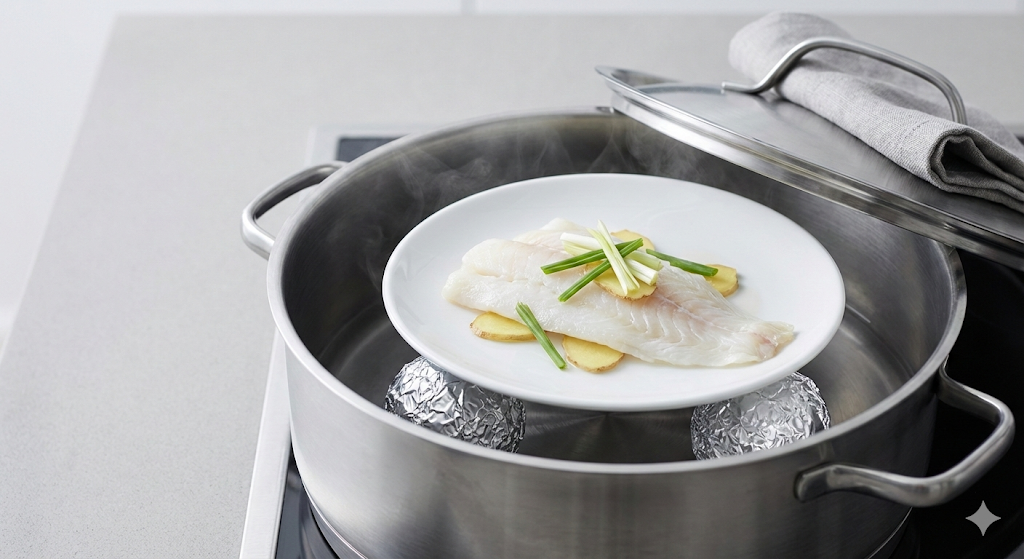
To steam fish without a bamboo steamer, the most effective method is to create an elevated platform inside a deep pot using crumpled aluminum foil balls, a heat-proof ramekin, or a metal colander. This setup lifts your plate above the boiling water, allowing hot steam to circulate evenly around the fish, while a tight-fitting lid traps the moisture necessary for that delicate, flaky texture.
How to Steam Fish Without a Bamboo Steamer: The “Foil Ball” Hack & 3 Other Methods
You have a beautiful, fresh fillet of snapper or sea bass on your counter. The ginger is sliced, the soy sauce is ready, and you’re craving that silky, melt-in-your-mouth texture that only steaming can provide. But then, you open your cabinet and realize the bamboo steamer is missing—or maybe you never owned one in the first place. Does this mean you have to settle for frying or baking, drying out that expensive catch? Absolutely not. In fact, relying on single-use gadgets is one of the biggest bottlenecks I see in both home kitchens and small catering startups.
The truth is, you don’t need traditional equipment to achieve world-class results. In my fifteen years of developing recipes and running commercial kitchens, I’ve found that a heavy-bottomed Dutch oven often creates a better heat seal than a cheap, woven basket. The goal isn’t the tool; it’s the environment: moist heat, circulation, and gentle temperature control. If you have a pot and some aluminum foil, you are already ninety percent of the way there.
USDA Food Safety Guidelines emphasize that cooking seafood to the right internal temperature is critical, and steaming is one of the most reliable ways to get there without overcooking. Let’s dive into the mechanics of how to steam fish without a bamboo steamer and turn a potential kitchen disaster into your new secret technique.
The “MacGyver” Setup 3 Ways to Elevate Your Fish
The core physics of steaming are simple: you need boiling water at the bottom, the food suspended in the middle, and a lid on top to trap the vapor. When consulting for small bistros that want to add seafood to the menu without buying industrial steamers, I always teach them to build their own architecture. It saves money, and honestly, it works just as well.
Here are the three most reliable architectures I use in the field:
1. The Foil Ball Tripod (Best for Stability)
This is my go-to method because it is infinitely adjustable. If your pot is wide or narrow, shallow or deep, foil adapts.
- The Method: Take three sheets of heavy-duty aluminum foil. Crumple them into tight, dense balls about the size of a golf ball.
- Field Context: I once had to cater a pop-up dinner in a bare-bones rental kitchen. We had zero racks. We used this foil trick to steam twenty whole branzinos simultaneously in hotel pans. The key is ensuring the balls are the exact same height so your plate sits level. If the plate tilts, your delicious soy-ginger sauce will slide right off into the water.
2. The Chopstick Raft (Best for Woks)
If you are using a wok or a pot with slanted sides, this method is classic.
- The Method: Cross two pairs of wooden chopsticks (unpainted/untreated) at the bottom of the wok to form a tic-tac-toe grid or a simple “X”.
- Pro Tip: Make sure the water level is below the chopsticks. If the water touches the wood constantly, they can float away or wobble.
3. The Heat-Proof Ramekin (The Easiest)
If you have a small ceramic bowl or a heat-proof ramekin, place it upside down in the center of your pot.
- The Method: Place your plate of fish directly on top of the upside-down bowl.
- Field Context: The only downside here is height management. If your ramekin is too tall, you might not be able to close the pot lid properly. Always check the “clearance” before you turn on the heat.
⚠️ Important! Never use a plate that isn’t heat-proof. Standard dinnerware can crack under the thermal shock of steam. Stick to ceramic, Pyrex, or stainless steel plates when you steam fish without a bamboo steamer.
Crucial Step Managing Condensation (The “Tea Towel” Trick)
Here is the one thing most articles won’t tell you, and it is the reason your previous attempts might have resulted in a “watery” mess.
A bamboo steamer is naturally breathable; it lets excess steam escape and absorbs dripping water. A metal pot lid does not. When steam hits the cold metal lid, it condenses back into water droplets. Gravity then pulls those droplets straight down—right onto your delicate fish fillets. This dilutes your seasoning and makes the texture soggy.
The Solution: Wrap your pot lid in a clean, dry kitchen towel before placing it on the pot. Gather the ends of the towel on top of the lid handle (secure them with a rubber band if necessary) so they don’t dangle near the burner flame. The towel absorbs the condensation, ensuring that only pure, hot steam cooks your food. In my opinion, this step is non-negotiable if you want professional results.
The “Safety Harness” Technique Retrieving Your Dish Safely
One specific pain point I hear from my students constantly is: “Okay, the fish is cooked, but how do I get a scorching hot plate out of a deep pot without burning my hands?”
Standard oven mitts are too bulky to fit into the gap between the plate and the pot wall. I’ve seen cooks try to use two forks and end up dropping the entire dinner back into the boiling water.
The Fix: Build a “sling” or “harness” before you even start cooking.
- Take a long sheet of aluminum foil (about 2 feet long).
- Fold it lengthwise continuously until you have a sturdy strip about 2-3 inches wide.
- Place this strip across your foil balls or ramekin before you put the plate down.
- Place the plate on top of the strip.
- Leave the two “handles” of the foil strip sticking up the sides of the pot.
When the timer goes off, simply grab the two cool ends of the foil strip and lift the plate straight out. It acts like a custom elevator for your fish. This simple preparation step changes the entire experience of trying to steam fish without a bamboo steamer from stressful to effortless.
Alternative Method The “En Papillote” (Oven Steaming) Technique
Sometimes, your stove is completely occupied with rice, soups, and stir-frys. In professional kitchens, when we run out of burner space during a Saturday night rush, we pivot to the oven. This method is technically called En Papillote (French for “in parchment”), and it effectively allows you to steam fish without a bamboo steamer by creating a sealed steam packet.
While this isn’t “wet” steaming like the pot method, it produces a similarly juicy result. You simply wrap the fish tightly in parchment paper or aluminum foil with a splash of wine, soy sauce, or water. The liquid boils inside the packet, inflating it like a balloon.
My recommendation: If you want that traditional, silky Chinese-style texture, stick to the pot method I described earlier. En Papillote tends to “roast-steam” the fish, resulting in slightly firmer flesh. However, for sheer convenience and zero cleanup, it is a fantastic backup plan.
Timing Adjustments Why Metal Pots Cook Faster Than Bamboo
If you are following a traditional recipe designed for a bamboo basket, you need to be careful. Bamboo is porous; it loses heat and steam constantly. A Dutch oven or stainless steel pot, however, is a heat trap. It retains energy much more efficiently.
In my experience testing recipes for my blog, I have found that when you steam fish without a bamboo steamer using a heavy metal pot with a tight lid, the cooking time decreases by about 20%.
- Bamboo Recipe: Says 10 minutes?
- Metal Pot Reality: Check it at 7 or 8 minutes.
Overcooking is the enemy of seafood. A few extra minutes in a high-efficiency metal pot can turn a succulent fillet into something that tastes like a rubber eraser.
Common Mistakes Why Your Fish Turned Out Rubbery
I learned this the hard way during my first year as a commis chef. I was tasked with steaming fifty portions of cod, and I treated the water like I was boiling pasta.
- The “Rolling Boil” Error: You do not want a violent, rolling boil. If the water is boiling too hard, the bubbles can splash up and hit the plate, flooding your fish with plain water. You want a steady, gentle steam generation.
- Overcrowding the Pot: If the plate is touching the walls of the pot, steam cannot circulate to the top of the fish. There must be a gap of at least one inch all around the plate.
- Skipping the Pre-Heat: Never put the fish in cold water and bring it up to heat. You must wait until the steam is already billowing before you place the fish inside. This ensures the proteins set instantly, locking in the juices.
⚠️ Important!
How do you know it’s done? Take a butter knife or a metal skewer and poke the thickest part of the fillet. If it slides through with zero resistance—like pushing into room-temperature butter—it is perfect. If there is rubbery resistance, cover it back up for another minute.
Quick Reference Minimum Water Levels for Different Pot Sizes
You need enough water to generate steam for 10-15 minutes, but not so much that it touches your food.
| Pot Size | Water Depth | Note |
| Small Saucepan (2qt) | 1.0 inch | Watch closely, evaporates fast. |
| Medium Dutch Oven (5qt) | 1.5 inches | The sweet spot for most fillets. |
| Large Stock Pot (8qt+) | 2.0 inches | Takes longer to boil, but stable. |
5 Steps to Perfect Stovetop Steaming
Here is the definitive workflow. If you follow these steps, you can steam fish without a bamboo steamer better than most restaurants.
- Build Your Foundation: Place your three aluminum foil balls (or ramekin) in the bottom of your wide pot. Pour water in until it comes about halfway up the height of your balls. The water must NOT touch the top of the balls.
- Create the Safety Sling: Fold your long strip of foil and lay it across the balls, leaving the handles sticking up.
- Fire It Up: Cover the pot (don’t forget the tea towel on the lid!) and bring the water to a boil. Wait until you see steam escaping.
- Load the Cargo: Season your fish on a heat-proof plate. carefully lower the plate onto the foil balls using your foil sling.
- The Steam & Retrieve: Cover immediately. Turn the heat down to medium-high. Steam for 8-10 minutes (depending on thickness). Use the foil handles to lift the plate out safely. Pour hot oil over the aromatics (optional) and serve.
Master the Art of Adaptation
Cooking isn’t about having the perfect gadget for every single task; it is about understanding how heat works and adapting to your environment. Whether you are running a small catering business or just trying to get a healthy dinner on the table for your family, knowing how to steam fish without a bamboo steamer is a skill that proves you are a capable cook.
Don’t let a lack of equipment stop you from buying that beautiful whole fish at the market. Grab some foil, grab a pot, and trust your instincts. The result will be honest, delicious, and entirely yours.
Frequently Asked Questions
Can I cook frozen fish using this method?
Technically, yes, but I advise against it for steaming. Steaming is a gentle cooking method that highlights the texture of the fish. Frozen fish releases a lot of excess water as it thaws, which can pool on the plate and make the sauce watery. For the best results when you steam fish without a bamboo steamer, thaw the fish completely in the refrigerator overnight first.
What if I don’t have aluminum foil?
No problem. You can use almost anything heat-proof to elevate the plate. I have used metal cookie cutters, empty tuna cans (labels removed and washed thoroughly), or even a few ceramic soup spoons arranged in a circle. As long as it lifts the plate above the water and is stable, it works.
Can I steam vegetables with the fish?
Absolutely. This is a great way to make a one-plate meal. However, keep in mind that dense vegetables like carrots take longer to cook than fish. I recommend using quick-cooking veggies like bok choy, asparagus, or sugar snap peas. Place them under the fish fillet so they absorb the savory juices as they cook.