
5 Foolproof Steps How to Cure Salmon with Himalayan Pink Salt
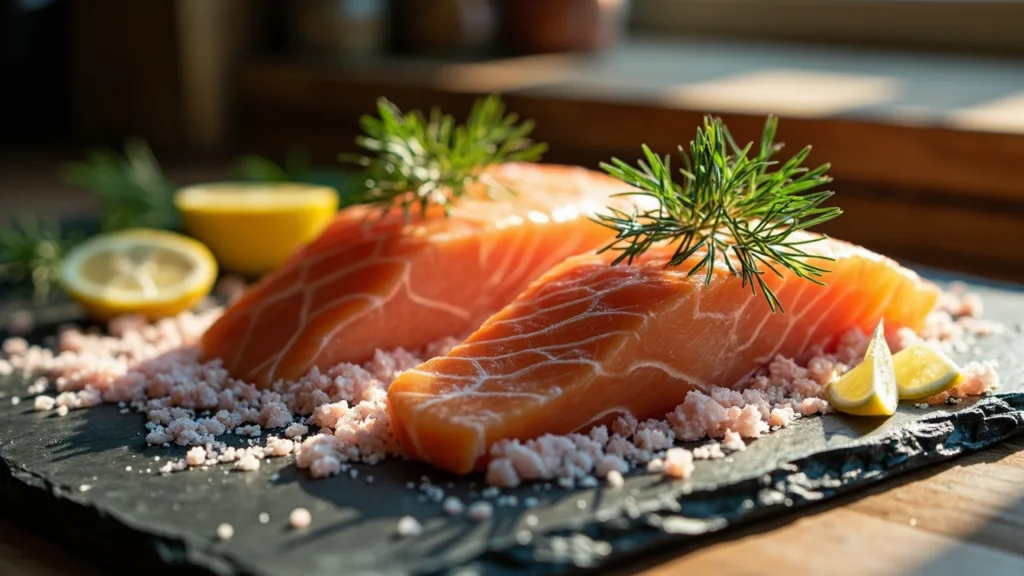
Learning how to cure salmon with Himalayan pink salt is a culinary game-changer. In fact, it transforms a simple, fresh fillet into a luxurious, silky, and flavorful delicacy reminiscent of high-end gravlax or lox. However, a common mistake we see is home cooks attempting this technique and ending up with a mushy, overly salty, or—worse—unsafe product. Often, this is because they fail to understand the specific properties of Himalayan salt and the critical science of curing.
Consequently, as culinary professionals, we’ve spent years perfecting this method. This guide will walk you through the foolproof, step-by-step process for curing salmon using Himalayan pink salt. We will cover the crucial safety distinctions, the exact ratios, and the expert tips that guarantee a perfect cure every single time. Ultimately, this is not just a recipe; it’s a foundational technique.
A Critical Safety Warning: Himalayan Pink Salt vs. “Pink Curing Salt”
First, before we go one step further, we must address a critical and dangerous point of confusion. Indeed, this is the most common mistake and one that has serious safety implications.
Himalayan Pink Salt (what we ARE using): This is a natural, unrefined rock salt (sodium chloride) harvested from the Punjab region of Pakistan. Its pink color comes from trace minerals like iron oxide. It is a finishing salt or cooking salt. It contains NO nitrites or nitrates.
Pink Curing Salt (what we are NOT using): This is also known as Prague Powder #1 or Curing Salt #1. Instead, it is 93.75% regular table salt and 6.25% sodium nitrite, which manufacturers dye pink to prevent accidental consumption. Chefs use this powerful preservative for making cured meats like bacon, ham, and corned beef. It is NOT Himalayan salt, and you should handle it with extreme care according to specific recipes.
Based on our analysis, confusing these two can be disastrous. For example, using Prague Powder in the quantity required for this salmon cure would result in a product that is potentially toxic. Conversely, using Himalayan salt to cure bacon would result in a product that lacks preservation and is unsafe to store. Therefore, for this recipe, we are only using the natural, edible Himalayan pink salt.
Why Cure Salmon with Himalayan Pink Salt Specifically?
So, with so many salts available, why choose Himalayan pink salt for curing? The practice is all about flavor and texture. Standard kosher or sea salt is almost pure sodium chloride, providing a sharp, direct saltiness. Himalayan pink salt, on the other hand, due to its mineral content, provides a more complex, milder, and less “stinging” salinity. This, of course, is the same reason chefs prize it in these 11 Himalayan pink salt cooking tricks.
As a result, the cure enhances the delicate flavor of the fish itself, rather than overpowering it. The mineral notes add a subtle, earthy backbone that is truly unique. Furthermore, the typical coarse grind of Himalayan salt is ideal for curing, as it dissolves slowly, drawing out moisture from the fillet at a steady, controlled pace. Finally, this helps achieve that perfect, firm, and silky texture.
The 5 Foolproof Steps to Cure Salmon with Himalayan Pink Salt
This process is all about ratios and patience. Follow these steps precisely, and you will not fail. The total active time is minimal, but the inactive “curing” time is where the magic happens.
First: Gather Your Ingredients and Tools
Before you begin the cure, the best practice is to have everything ready. You will need your fresh, sushi-grade salmon fillet, your cure ingredients, and a non-reactive dish (glass or ceramic is perfect). A common error is using an aluminum pan, which can react with the salt, so you should avoid that.
Step 1: Select Your Salmon (The Foundation)
To begin, this is not the time for bargain-hunting. Because the fish is not “cooked” with heat, you must use the highest quality salmon you can find. The best practice is to purchase a sushi-grade or sashimi-grade fillet. Instead, go to a reputable fishmonger and tell them you intend to cure it.
We recommend a 1 to 2-pound fillet, preferably a center-cut piece, with the skin on. The skin helps the fillet hold its shape during the curing process. Check the fish for any small pin bones by running your fingers against the grain. Remove any you find with clean tweezers or pliers.
Step 2: Prepare the Pink Salt Cure
Now, this is where the core technique lies. The cure is a mixture of salt, sugar, and aromatics. The salt and sugar work together via osmosis—the salt draws moisture out of the salmon, while the sugar balances the flavor and also contributes to the firming of the texture. A common mistake is getting the ratio wrong.
The Expert Ratio: For instance, for curing salmon with Himalayan pink salt, our analysis shows a 1:1 ratio by weight of coarse Himalayan pink salt to sugar is the perfect starting point. If you only have a volume measure (cups), use 1 part coarse Himalayan pink salt to 1 part granulated white sugar.
For a 2-pound (approx. 900g) fillet, you will need:
- 1/2 cup coarse Himalayan pink salt
- 1/2 cup granulated white sugar
- 1 tablespoon coarsely crushed black peppercorns
- 1 large bunch of fresh dill, roughly chopped (stems and all)
- (Optional) Zest of 1 lemon or orange
Afterward, mix all these ingredients together in a bowl. The aromatics, like the peppercorns, are a foundational flavor element, much like those used in making a complex homemade chili oil. Do not skimp on the dill; it is the classic flavor of gravlax.
Step 3: Pack and Wrap the Salmon
First, select a non-reactive dish. This means glass, ceramic, or stainless steel. A common error is using an aluminum pan, which can react with the salt and acid, giving the fish a metallic taste.
- Pat the salmon fillet completely dry with paper towels.
- Spread about one-third of the cure mixture on the bottom of your dish in the shape of your fillet.
- Place the salmon fillet, skin-side down, on top of the cure.
- Cover the entire flesh side of the salmon with the remaining two-thirds of the cure. Be sure to get the sides and ends.
- Lay the chopped dill on top of the cure.
- Cover the entire dish tightly with plastic wrap, pressing it down to make contact with the fish.
Step 4: The Curing Process (Weigh it Down)
Now, this step is where patience pays off. Place the wrapped dish in the refrigerator. Then, place a weight on top of the plastic-wrapped fish. This can be a smaller dish, a few cans of beans, or even a brick you have wrapped in foil. This weight is crucial for pressing out moisture and ensuring a firm, dense final product.
How long to cure salmon? The timing depends on the thickness of your fillet.
- For a thin fillet (around 1 inch): 48 hours (2 days) is perfect.
- For a thick, king salmon fillet (1.5-2 inches): 72 hours (3 days) is necessary.
Once every 24 hours, unwrap the fish, drain off the liquid (brine) that has been pulled from the salmon, flip the fillet over (so it’s skin-side up), and re-wrap it tightly, placing the weight back on top. This ensures an even cure.
Step 5: The Rinse, Dry, and Rest (The Finish)
Finally, after 48-72 hours, your salmon has cured. It will feel very firm to the touch, similar to a cooked steak. Now, you must remove the cure.
- Unwrap the salmon and discard all the aromatics and sludge.
- Next, rinse the fillet under cold running water. Be quick! A common mistake is soaking or rinsing for too long, which makes the fish absorb water and become mushy. You are just rinsing off the excess salt, sugar, and aromatics.
- Then, pat the fillet completely dry with paper towels. It should feel firm and look beautifully translucent.
- The Pro Step (Pellicle): For the best texture, the practice is to now place the rinsed, dried salmon fillet on a wire rack over a baking sheet, uncovered, in the refrigerator for another 4-24 hours. This allows the surface to dry out further, forming a tacky layer called a “pellicle.” This makes slicing much easier and improves the texture.
How to Serve and Store Your Pink Salt Cured Salmon
To serve, place the cured salmon skin-side down on a cutting board. Using a long, very sharp slicing knife, cut the salmon on a deep bias (angle) into paper-thin slices, leaving the skin behind. This technique is similar to those chefs use in mastering European classics and requires a sharp knife.
Serve your Himalayan pink salt cured salmon on dark rye bread with cream cheese, with a side of mustard-dill sauce (a classic Scandinavian pairing), or simply on its own. The flavor is rich and complex. It’s a testament to the idea that fundamental techniques, like mastering stocks and sauces, are what create truly memorable food. This curing process is one of those fundamentals.
To store, wrap the unsliced block of salmon tightly in plastic wrap. It will keep in the refrigerator for 5 to 7 days. You can also freeze it, wrapped tightly, for up to 3 months.
Contrasting Techniques: Why This Isn’t Chinese or Stir-Fry Cooking
Of course, it’s important to understand this “cold” preservation technique in context. Curing is about the slow, deliberate removal of moisture. In fact, this is the polar opposite of many high-heat techniques, for example, in mastering authentic Chinese food, where the goal is to flash-cook ingredients to *retain* moisture and texture. For example, a perfect stir-fry relies on “wok hei” (the breath of the wok), where the chef applies the salt and flavor from something like a well-balanced stir-fry sauce instantly with intense heat. Curing is a marathon, not a sprint. Ultimately, both are about flavor, but the scientific approach is entirely different.
Expert Summary: The 3 Keys to Success
- Safety First: Know the difference between Himalayan Pink Salt (food) and Pink Curing Salt (nitrite).
- The 1:1 Ratio: Use a 1-to-1 ratio of coarse pink salt to sugar by weight or volume.
- Patience: Weigh the salmon down and cure for 48-72 hours, flipping daily.
This process is as simple and reliable as the gravlax recipes from high-authority sources like Bon Appétit, but adapted for the unique, mineral flavor of Himalayan pink salt.
Expert Answers to Your Salmon Curing Questions
Can I use fine-ground Himalayan pink salt instead of coarse?
The best practice is to use coarse salt. Fine salt will dissolve much faster and can make the exterior of the salmon intensely salty before the center has fully cured. If you must use fine salt, you must measure by weight, not volume, as a cup of fine salt is much denser and saltier than a cup of coarse salt. Use the 1:1 salt-to-sugar ratio by weight.
Why is my cured salmon mushy instead of firm?
This is a very common problem and points to one of two errors: 1) The salmon was not fresh enough (not sushi-grade) to begin with, or 2) You did not cure it long enough. If your fillet was thick, it may have needed the full 72 hours. A mushy texture means the osmotic process did not complete and the cure did not remove enough moisture.
Do I absolutely have to use sugar in the cure?
Yes. From a culinary perspective, sugar is not optional. Curing with 100% salt (a “salt box” cure) will result in a product that is extremely salty and has a tough, dry texture. The sugar balances the harshness of the salt and, more importantly, it helps create the delicate, silky texture that cured salmon is famous for.
How is this pink salt cured salmon different from lox?
A critical distinction! This Himalayan pink salt cured salmon is essentially a gravlax. Traditionally, chefs cold-smoke Lox after the curing process, while gravlax is not. Our recipe does not involve any smoking, giving it a cleaner, brighter flavor that highlights the salmon and the mineral notes of the pink salt.
Is it truly safe to eat this “raw” salmon?
Safety is paramount. The heavy concentration of salt and sugar makes the environment inhospitable to most bacterial growth. This process is thousands of years old. However, safety depends on two factors: 1) You must start with sushi-grade fish, which suppliers have handled in a way to make it safe for raw consumption, and 2) You must keep the salmon refrigerated at all times during and after curing. It is not a shelf-stable product like jerky.


![9 Essential Chinese Pantry Staples to Boost Your Menu Profits [Insider Tips]](https://lezata.com/wp-content/uploads/2025/10/3c67ea0a-9945-437f-bbae-a6328259b7e9_019a2daa-6358-71bf-8a40-2290876b8ccf_files_essential_chinese_pantry_staples-768x432.webp "9 Essential Chinese Pantry Staples to Boost Your Menu Profits [Insider Tips] 6")
